Automation That Doesn’t Interrupt Production
Most automation doesn’t fail because it’s wrong. It fails because it’s disruptive. Rollouts take too long. Performance dips during the transition. Teams lose confidence before the system has a chance to prove itself.
So leaders hesitate — and they should. The risk isn’t the technology. The risk is what happens to the operation while the technology is being installed. This piece is about how to eliminate that risk entirely.
Why Rollouts Fail
The conventional automation rollout follows a familiar script. A team spends months evaluating vendors, building a business case, and getting approval. Then the project starts: site surveys, system design, hardware installation, software integration, testing, training, go-live. The whole thing spans six months to a year, during which the operation is partially under construction.
At some point during that window, production takes a hit. Maybe it’s the week the racking gets reconfigured. Maybe it’s the two weeks where the old process and the new process run in parallel and neither works properly. Maybe it’s the month after go-live when the team is still learning the system and throughput drops 15% before it starts climbing again.
That dip is the project’s most dangerous moment. Not because the technology is wrong, but because confidence is fragile. When throughput drops during an automation rollout, the narrative changes. The team on the floor starts saying “I told you this wouldn’t work.” The supervisors who were skeptical feel validated. The operations manager who championed the project starts defending instead of leading.
Even if performance recovers — and it usually does — the trust damage is done. The next automation project will face twice the internal resistance, because everyone remembers the last one as the thing that made their lives harder before it made them better.
This isn’t a technology problem. It’s a deployment problem. And the solution isn’t better technology. It’s a fundamentally different approach to how automation enters an operation.
The Disruption Tax
Every automation project imposes a disruption tax on the operation. It’s the sum of all the small costs that don’t appear in the project budget but are very real to the people doing the work:
Zones go offline, aisles get blocked, workflows reroute around construction. The operation absorbs the delay, but at a cost.
During the transition, some areas run the old way and some run the new way. Workers toggle between two systems, neither of which they fully trust. Errors spike.
Pulling workers off the floor for training sessions means fewer picks happening. And training on a system that isn’t fully installed yet is training on theory, not practice.
Every hour supervisors and ops managers spend managing the rollout is an hour they’re not managing the operation. The project consumes the people who are supposed to keep things running.
Change is stressful. Extended change is exhausting. When a rollout stretches across months, the team’s patience wears thin well before the system proves its value.
The disruption tax is the reason leaders hesitate. Not because they don’t believe automation works, but because they’ve done the mental math on what the transition costs — and they’re not sure the operation can absorb it right now. Peak season is coming. Staffing is tight. There’s a new client onboarding next month. There’s always a reason to wait.
The problem with waiting is that the inefficiency the automation would fix is also compounding. Every month of delay is another month of mispicks, wasted travel time, and extended training cycles. The disruption tax of doing nothing is invisible but relentless.
The answer isn’t to push through the disruption. It’s to deploy in a way that doesn’t create it.
Start Smaller Than You Think
The instinct with automation is to plan big. Map the entire warehouse. Design the end-state. Build a 200-device deployment plan. Calculate the ROI against full-floor coverage. Present the vision to leadership. Get approval for the whole thing or nothing.
That instinct is exactly what creates the disruption problem. Big plans require big rollouts. Big rollouts take months. Months of transition mean months of disruption.
The better approach starts smaller than most people are comfortable with. Not as a compromise — as a strategy.
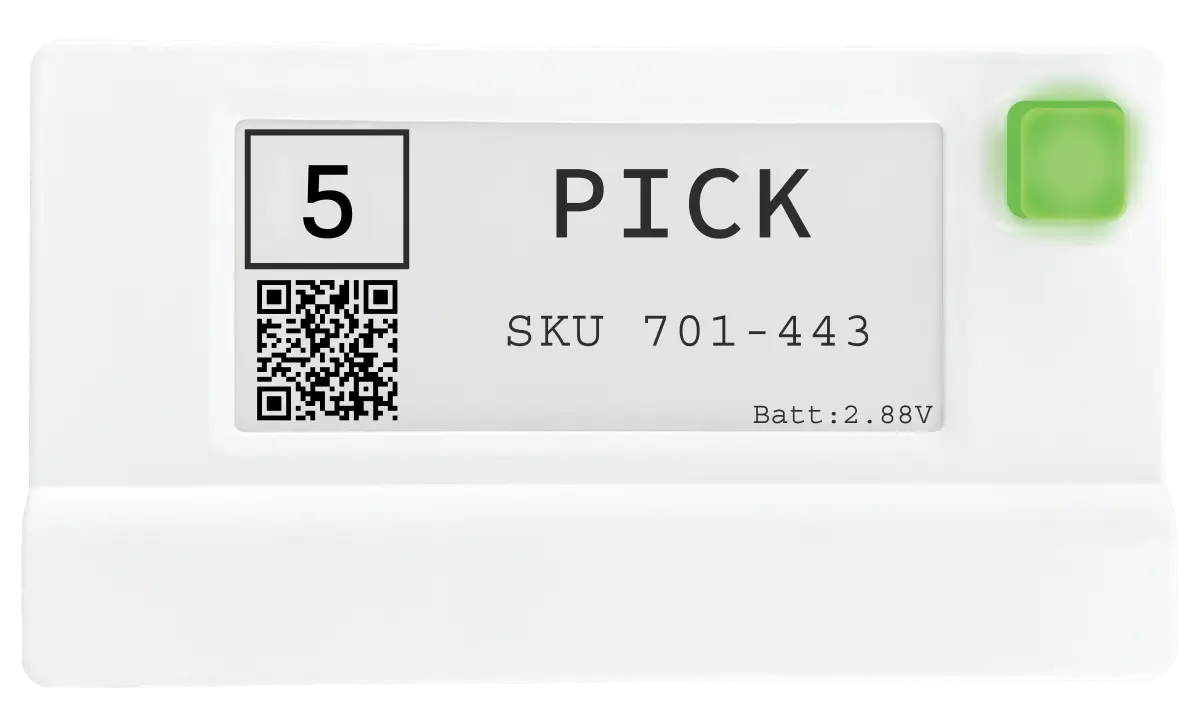
One workflow. One zone. A handful of wireless pick-to-light devices. Enough to cover a single, specific, measurable process — like the top 30 SKUs in a pick zone, or a put wall for the highest-volume customer, or a kitting station that runs the same assemblies every day. The devices mount with magnets, connect over Wi-Fi, and start guiding picks within hours of unboxing — no racking changes, no wiring runs, no IT projects.
The point of starting small isn’t to test the technology. The technology works. You can verify that in an afternoon. The point is to prove the impact — to demonstrate, in your own environment, with your own products and your own team, that the system makes the work measurably better.
A small deployment does something a big plan can’t: it delivers evidence before it demands commitment. The supervisor sees pick rates improve in a specific zone. The team sees a new hire get productive in two days instead of two weeks. The operations manager sees error rates drop in a measurable, attributable way. That evidence doesn’t need a business case. It is the business case.

What a Strong Pilot Actually Looks Like
Not all pilots are equal. A weak pilot picks a low-stakes zone, deploys with minimal oversight, and produces ambiguous results that neither prove nor disprove anything. A strong pilot is designed to answer a specific question with clear evidence.
Here’s what separates the two:
Weak Pilot
- •Deployed in a quiet zone that nobody watches closely
- •No baseline metrics captured before deployment
- •Success defined vaguely: “see if the team likes it”
- •No defined timeline or decision point
- •Results discussed anecdotally in a meeting three months later
Strong Pilot
- •Deployed in a zone with visible pain: high error rates, slow training, or bottleneck flow
- •Baseline measured before go-live: pick rate, errors, training days, supervisor time
- •Success defined clearly: “reduce mispicks by 40%” or “cut new-hire training to 3 days”
- •30–60 day evaluation window with a scheduled review
- •Results documented with numbers that leadership can act on
A strong pilot doesn’t try to answer every question. It answers one question decisively — and that answer becomes the foundation for everything that follows.
The best pilots also generate an unexpected benefit: internal advocates. The team in the pilot zone becomes the team that tells everyone else how much better the work is. That peer-to-peer evidence is worth more than any vendor presentation, because it comes from people who do the same job in the same building.
One Question, Not Ten
The most common mistake in pilot design is trying to evaluate everything at once. Can the system handle our SKU count? Will it work with our WMS? What about multi-floor operations? Can it support kitting and put-wall workflows simultaneously? What’s the error rate improvement? What’s the ROI at full scale?
These are all good questions. But trying to answer all of them in a 30-day pilot creates an evaluation so complex that no outcome feels conclusive. The data is spread too thin. The scope is too broad. And the team running the pilot is too distracted by edge cases to pay attention to the fundamental question:
Does this make the work easier here?
That’s the question. Not “could this theoretically work at scale?” Not “does it integrate with every system we might use in three years?” Just: in this zone, with these people, for this workflow, does the system make the work measurably easier?
If the answer is yes — if pickers are faster, errors are down, new hires are productive sooner, and the supervisor has time to think — then every other question becomes an engineering detail. Scaling is a matter of buying more devices. Integration is a matter of API calls. Multi-floor support is a matter of router placement. None of those are hard once the fundamental question has been answered.
If the answer is no, you’ve spent 30 days and a modest investment to learn that — without disrupting the rest of the operation. That’s not a failure. That’s the cheapest market research you’ll ever do.
Fitting Into What Already Exists
One of the underappreciated reasons automation stalls isn’t cost or complexity — it’s uncertainty about how the new system fits into the existing one. Operations teams have spent years building processes, workflows, and system integrations that work. They’re imperfect, but they’re understood. Introducing something new raises a reasonable fear: what if it breaks what already works?
This fear is especially acute around WMS integration. The warehouse management system is the nervous system of the operation. If the automation requires changes to the WMS, the project just became an IT project — and IT projects have their own timeline, their own approval process, and their own disruption risk. Suddenly the automation pilot is gated behind a software change request that might take months.
Systems that are designed to fit into existing infrastructure — rather than requiring the infrastructure to change — eliminate this bottleneck entirely. A REST API call, a browser extension, a webhook listener. These aren’t compromises. They’re architectural choices that respect the fact that the operation was running before the automation arrived and needs to keep running while it’s deployed.
The practical test is simple: can the system be deployed in the pilot zone without a single change to the WMS, the ERP, or the network? If the answer is yes, the pilot timeline collapses from months to days. If the answer is no, every dependency becomes a risk to the schedule and a reason for the project to stall.
Voodoo Robotics takes this approach deliberately. The system connects via REST API and publishes free, open-source integration code for platforms like Extensiv, ShipStation, Odoo, SAP, and Epicor — so the pilot deploys without touching your WMS configuration. If integration is a concern in your evaluation, it’s worth understanding how pick-to-light connects into existing warehouse environments.
The Goal Isn’t Rollout — It’s Confidence
There’s a reason this piece keeps returning to the word “confidence.” It’s the thing that’s actually at stake in any automation decision — and it operates at every level of the organization.
The picker needs confidence that the device is showing the right information. The supervisor needs confidence that the system won’t create more problems than it solves. The operations manager needs confidence that the investment will pay back. The executive needs confidence that the project won’t embarrass the team.
A pilot that’s designed correctly builds confidence at every level simultaneously. The picker sees the device work correctly, hundreds of times a day, and stops double-checking. The supervisor sees the questions stop and realizes the system is doing what they used to do. The operations manager sees the numbers and has data to support expansion. The executive hears the floor team advocating for more devices instead of complaining about another IT project.
That’s the cascade. And it can’t be manufactured by a vendor presentation, a reference call, or an ROI spreadsheet. It can only come from lived experience in the customer’s own operation, with their own people, on their own floor.
If you already have a picture of what better execution looks like — what changes when the system keeps up, how hesitation disappears, where the time actually comes back — the pilot is the step that makes it real. For that picture, see What Changes on the Floor When the System Actually Keeps Up.
What Happens After the Pilot
When a pilot works — when the data is clear, the team is positive, and the impact is measurable — the question shifts from “should we do this?” to “where else should we do this?”
And here’s where the non-disruptive approach pays its largest dividend: expansion looks exactly like the pilot. Same devices. Same deployment process. Same lack of downtime. Adding a second zone doesn’t require a new project plan, a new vendor engagement, or a new round of change management. It requires more devices and a few hours of setup.
This is the architectural advantage of systems that are designed to grow incrementally rather than deploy monolithically. Each expansion is small, self-contained, and additive. The operation doesn’t absorb a transition — it absorbs a slight extension of something that’s already working.
The most common expansion pattern is organic and bottom-up. The team in the pilot zone tells the team in the adjacent zone what changed. The adjacent zone’s supervisor asks for devices. The operations manager approves because the data from the pilot makes the decision obvious. No executive presentation required. No six-month project plan. Just the same thing, in one more place.
Over time, the coverage grows from one zone to a floor, from one workflow to several. But at no point does the operation experience the disruption that a traditional full-floor rollout would impose. The growth is continuous, and each step is validated by the one before it.
This is what it means to automate without interrupting production. Not a careful, minimal deployment that avoids impact. A deployment strategy that generates impact — measurable, visible, team-endorsed impact — without ever requiring the operation to pause.
If this approach resonates, Voodoo Robotics wireless pick-to-light was designed for exactly this deployment model. Start with a handful of devices in your highest-pain zone, measure the impact over 30 days, and let the results drive the next step. See pilot pricing or talk to someone who has done this before.
Start With One Zone. Prove the Impact.
A Voodoo Robotics pilot deploys in days, runs alongside your existing workflow, and delivers measurable results before you commit to anything else.