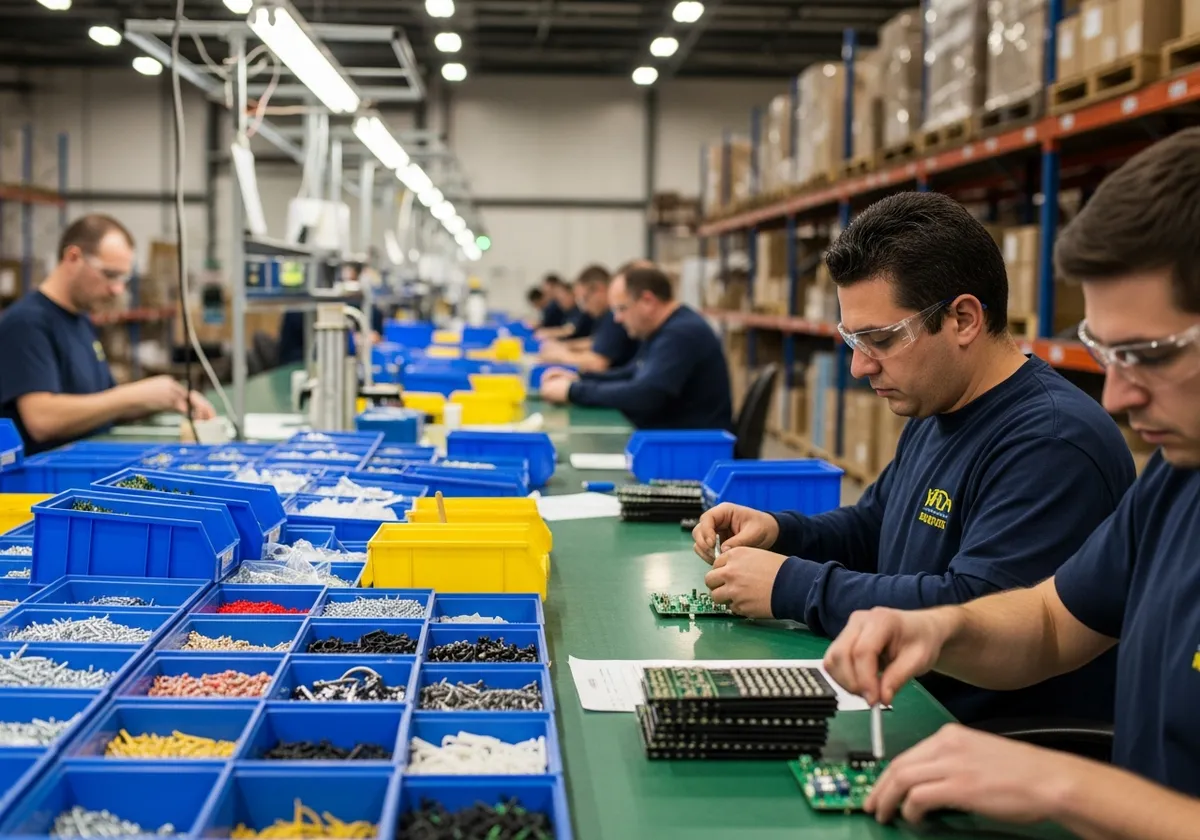
Kitting and Sequencing — Build It Right the First Time
Kitting and sequencing operations require exact component selection in exact order. A single missed part or wrong sequence can scrap an entire assembly. Voodoo's wireless light-directed displays guide operators step-by-step through multi-component builds, lighting up the correct part bin in order and confirming each pick before advancing. Whether you call it kitting, assembly sequencing, or line-side replenishment, the principle is the same: eliminate human error from complex, repetitive processes.
Light-Directed Assembly in Four Steps
Every kitting and assembly workflow follows the same guided sequence — load, pick, confirm, complete. The system enforces the correct order so operators never miss a step.
Work Order Loads
Displays light up the first component bin in the sequence, showing part number and quantity needed.
Operator Picks
The operator picks the lit component — the display shows part number, quantity, and placement instructions.
Confirm & Advance
A button press confirms the pick. The next bin in the sequence lights up automatically.
Kit Complete
All components confirmed — kit is complete and the system logs the build with full traceability.
Measurable Impact on Assembly Quality
Light-directed kitting transforms error-prone manual processes into guided, verifiable workflows. Results are immediate and measurable.
When to Use Kitting & Sequencing
- ●Multi-component assembly where sequence and part selection matter
- ●Production line kitting — delivering exactly the right parts to each station
- ●MRO and maintenance kits with mixed part types and regulated traceability
- ●Subscription box assembly with varying product mixes per tier
- ●Any pick-to-kit workflow where missing a single component scraps the build
Why Wireless Guided Kitting
- ●Reconfigure kitting stations and bin layouts in minutes — no rewiring
- ●Add part bins for new product lines without infrastructure changes
- ●Battery-powered displays last years — no power runs to each bin
- ●Deploy a light-directed assembly station in hours, not weeks
- ●Same Voodoo hardware used for pick-to-light also runs guided kitting
What It Integrates With
- ●Any WMS or MES via standard REST API for work order data
- ●ERP systems (SAP, Oracle) for BOM-driven kitting instructions
- ●Barcode scanners for component-level verification at each step
- ●Downstream pack-to-light for ship verification after kit assembly
- ●Cloud dashboard for build completion, cycle time, and error tracking
Kitting & Sequencing vs. Other Workflows
Light-directed assembly — also called guided kitting, pick-to-kit, or sequenced picking — enforces build order on every pick. Here's how it differs from other approaches.
Kitting vs. Pick to Light
Standard pick-to-light (pick-by-light) lights up locations for discrete order picking — any sequence works. Kitting and sequencing enforces a strict build order: each bin lights only after the previous step is confirmed. Both run on the same hardware, but kitting adds sequence enforcement for assembly-critical workflows.
Kitting vs. Batch Picking
Batch picking consolidates multiple orders into one retrieval trip — fast but unguided. Kitting (light-directed assembly) builds one complete kit at a time with verified component selection. Batch picking optimizes for speed across orders; kitting optimizes for accuracy within a single multi-component build.
Kitting vs. Pack to Light
Kitting guides the assembly of components into a complete kit — building the order. Pack-to-light (pack verification, ship verification) confirms the assembled order is correct at the pack station. They are sequential: kitting builds it, pack-to-light verifies it. For operations that need both, the same Voodoo displays handle both steps.
Where Light-Directed Kitting Delivers
From manufacturing floors to distribution centers, kitting and sequencing with visual guidance applies wherever operators assemble multi-component orders.
Manufacturing Kitting
Assemble component kits for production lines with exact part counts and sequence enforcement. Reduce line stoppages caused by missing or incorrect parts.
Automotive Parts Sequencing
Deliver parts to assembly stations in exact build order. Light-directed sequencing ensures the right component arrives at the right time for each vehicle.
Electronics Assembly
Guide operators through complex PCB and device assembly sequences where component orientation and placement order are critical.
Medical Device Kitting
Meet regulatory compliance requirements with fully traceable, light-directed kitting that logs every pick for audit trails and quality documentation.
Line-Side Replenishment
Displays at production line stations guide replenishment picks, ensuring the right materials reach the right workstation before stock runs out.
Will-Call Staging
Pre-build customer orders into staged kits for quick pickup. Each kit is verified complete before reaching the staging area.
Frequently Asked Questions
What is kitting?
What's the difference between kitting and sequencing?
How does light-directed kitting reduce errors?
Can this work for line-side replenishment?
What industries use light-directed kitting?
How does kitting integrate with our ERP or MES?
Ready to Eliminate Assembly Errors?
See how Voodoo's light-directed kitting and sequencing system works for your operation.