If You Can’t See It Happen, You’re Already Behind
Most operations don’t lack data. They lack timing. By the time reports are reviewed, the shift is over. The problem already happened. The correction comes too late to matter.
That’s the real visibility gap — not whether you can see what happened, but whether you can see it while it’s happening. This piece is about what changes when you close that gap.
The Reporting Illusion
Every modern warehouse has reports. Pick rates by zone. Error rates by shift. Throughput by hour. Units processed, orders completed, exceptions logged. The data exists, and most operations have people whose job is to look at it.
The problem isn’t the data. The problem is when it arrives.
A typical reporting cycle works like this: the shift runs, the data accumulates, someone exports it, someone else reviews it, patterns are identified, and corrective actions are discussed — usually in a meeting the next morning, sometimes at the end of the week. By the time anyone acts on the information, the conditions that created the problem have already changed. The team that was underperforming has rotated. The bottleneck that caused the backup has shifted to a different zone. The mispick has already shipped.
This creates a peculiar illusion: the operation feels data-driven because it has dashboards and KPIs and weekly reviews, but it’s actually operating on delayed information. Every decision is based on what already happened, not what’s happening. The team is steering by looking in the rearview mirror.
Most operations managers know this intuitively. They compensate by walking the floor — physically observing the work in real time because the reporting system can’t provide that view. But a person can only be in one zone at a time, and their observations are filtered through whatever they happen to notice. It’s better than nothing, but it’s not visibility. It’s anecdote.
What the Delay Actually Costs
The cost of delayed visibility isn’t abstract. It shows up in specific, recurring ways that most operations have learned to accept as normal:
A picker pulls the wrong item at 10 AM. The error isn’t caught until the next day’s quality review. By then, the order has shipped, the customer has received the wrong product, and the return cycle has begun. The cost isn’t the mispick — it’s the five downstream events that follow it.
Zone 4 falls behind at 11 AM because two pickers called in sick and the zone wasn’t rebalanced. By the time the shift lead notices — visually, while walking the floor — an hour of orders are backed up. If that information had been visible in real time, the rebalance could have happened in 10 minutes.
A new hire is consistently picking at 60% of the team average, but it doesn’t surface in reporting until the weekly review. By then, five shifts of below-average productivity have passed. Real-time visibility would have flagged the pattern on day one, allowing intervention while the training window is still open.
A putaway error places 200 units in the wrong location. The discrepancy doesn’t surface until a picker can’t find the product three days later and triggers a cycle count. By then, orders have been shorted, and the investigation takes hours. Real-time confirmation at putaway would have caught it immediately.
Every peak season, the same zones become bottlenecks. The reports from last year’s peak show the problem clearly, but by the time this year’s peak arrives, the specific conditions have changed enough that last year’s fix doesn’t apply. What’s needed isn’t better historical data — it’s the ability to see the bottleneck forming in real time and respond before it backs up.
Each of these costs is individually manageable. Together, they represent a permanent tax on the operation — a constant drag that’s accepted as unavoidable because the information needed to prevent it arrives too late.
The Difference Between Data and Visibility
Data tells you what happened. Visibility tells you what’s happening. The distinction sounds simple, but it changes everything about how an operation is managed.
Data is retrospective. It’s useful for trend analysis, capacity planning, and performance reviews. It answers the question: over the last week, month, or quarter, how did we perform? That information is valuable, but it’s not actionable in the moment. You can’t fix yesterday’s bottleneck. You can’t un-ship yesterday’s mispick.
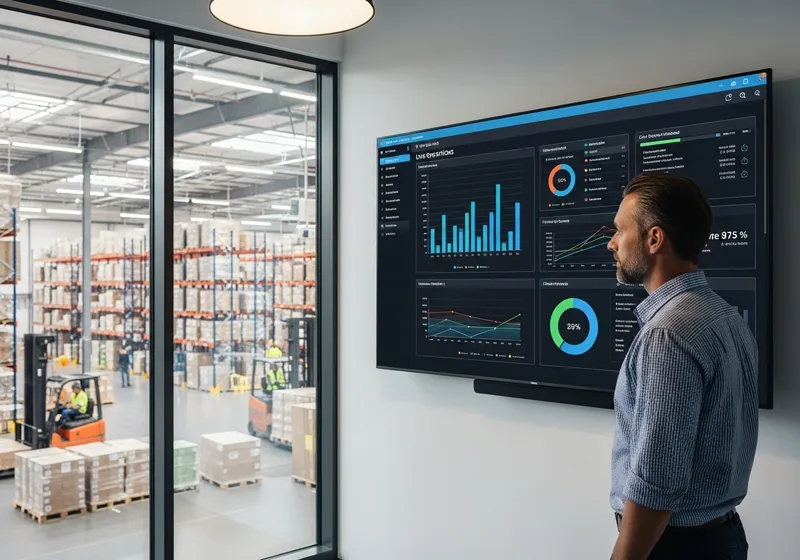
Visibility is present-tense. It answers a different set of questions: What is happening right now in zone 3? How many orders are waiting for picking? Which locations are being worked, and which are idle? Is the team in aisle 7 keeping pace, or falling behind? Those questions have answers that are actionable immediately — and the value of the answer decays with every minute of delay.
Think of it this way: a dashboard that shows yesterday’s pick rate is data. A system that shows which devices are being triggered right now, which confirmations are coming in, and which zones have gone quiet — that’s visibility. Both are built from the same underlying information. The difference is latency.
When a wireless pick-to-light device is triggered at a location, that event is information. If that event is logged to a database and reviewed tomorrow, it’s data. If it’s visible to a supervisor on a screen in real time — alongside every other active device in the building — it’s visibility. The cost of the hardware is the same. The cost of the software is the same. The difference in operational value is enormous.
What Supervisors Do With Real-Time Information
A supervisor without real-time visibility manages reactively. They respond to problems after those problems have been escalated — usually by a picker who has stopped working to come find them, or by a downstream process that’s starving for product. By the time the supervisor intervenes, minutes or hours of productivity have been lost.
A supervisor with real-time visibility manages proactively. They can see that zone 3 has slowed down before anyone comes to tell them. They can see that a particular aisle hasn’t had a device confirmation in 20 minutes and check whether the picker is stuck, confused, or working in the wrong area. They can see that put-wall activity is outpacing pick activity and rebalance labor before the wall fills up.
The decisions themselves aren’t different. Rebalancing labor, redirecting work, intervening on training issues — these are things supervisors already do. What changes is the timing. Instead of responding to a problem that’s been building for an hour, they’re responding to a pattern that’s been developing for five minutes. That difference in response time is the difference between a minor adjustment and an operational recovery.
There’s also a subtler effect: the nature of the conversation changes. When a supervisor intervenes because they can see real-time data, the interaction feels collaborative rather than punitive. “I noticed zone 3 has slowed down — what do you need?” is a fundamentally different conversation from “Zone 3 underperformed yesterday — what happened?” One is a problem being solved. The other is a problem being investigated. The team responds to those differently.
The best supervisors already try to manage this way. They walk the floor, they watch the flow, they develop an intuition for when something is off. Real-time visibility doesn’t replace that intuition — it amplifies it. It gives them eyes on every zone simultaneously, not just the one they happen to be standing in.
How Teams Self-Correct
One of the most interesting effects of real-time visibility is that it doesn’t just help supervisors manage — it helps teams manage themselves.
When the system provides immediate feedback — a device confirms a pick, a screen shows the next task, a zone’s progress is visible — the team develops a sense of pace. They can feel when they’re on track and when they’re falling behind, not because someone told them, but because the system’s feedback loop is tight enough that the information is self-evident.
This is the same principle that makes assembly lines work: the pace of the work is visible and shared. When one station falls behind, the stations around it can see it and adjust. In a warehouse, this kind of shared pacing is much harder to achieve because the work is distributed across a large physical space. A picker in aisle 2 has no idea whether the picker in aisle 8 is keeping up, because they can’t see each other.
Real-time visibility creates the informational equivalent of line-of-sight. Even though the team is physically dispersed, the system’s feedback — device confirmations, zone activity, queue depth — provides a shared sense of what’s happening. Lead pickers can see which areas need help. Experienced workers naturally gravitate toward the work that’s falling behind. The team starts self-organizing around the flow of work, rather than each person optimizing their own path.
This isn’t something you train. It’s something that emerges when the information environment is right. When people can see the work, they coordinate around it. When they can’t, they work in isolation. The difference between the two isn’t effort or skill — it’s whether the system provides the right information at the right time.
The Stabilization Effect
Operations without real-time visibility tend to oscillate. They have good shifts and bad shifts. Good weeks and bad weeks. Performance charts show spikes and valleys — a sawtooth pattern that never quite smooths out, no matter how much planning goes into the schedule.
The oscillation happens because problems go undetected long enough to cascade. A small issue in one zone becomes a backup that affects two adjacent zones. By the time the supervisor responds, they’re managing a multi-zone problem that started as a single-zone hiccup. The recovery consumes the rest of the shift, and tomorrow’s morning meeting is about yesterday’s fire.
Real-time visibility compresses the feedback loop. The hiccup is visible at five minutes, not fifty. The intervention is small — redirect one picker, rebalance one wave — instead of large. The cascade never develops. The shift finishes without a dramatic recovery because there was nothing dramatic to recover from.
The result isn’t a higher peak. It’s a higher floor. The best shifts don’t get much better — the operation was already capable of performing well on a good day. What changes is that the bad shifts get significantly less bad. The variance compresses. The sawtooth flattens into a line.
For operations managers, this is the metric that matters most and is talked about least. Consistency is harder to achieve than peak performance, and it’s worth more. A team that delivers 95% of target every single shift is more valuable than a team that oscillates between 110% and 75%. Labor planning becomes reliable. SLA commitments become predictable. The operation earns the trust of the customers who depend on it.
If you’ve already thought through how to adopt automation safely — one zone at a time, without interrupting what’s already working — this stabilization is what makes it sustainable. The pilot proves impact. The visibility sustains it. See Automation That Doesn’t Interrupt Production.
Visibility That Connects Back
Real-time visibility on the floor is powerful on its own. But the real leverage comes when that visibility connects back to the broader systems that manage the operation — the WMS, the ERP, the order management platform.
When a pick-to-light device confirms a pick, that’s an event. If that event lives only on the floor — visible to the picker and maybe the supervisor — it’s useful but isolated. If that event feeds back to the WMS in real time, updating inventory at the point of pick, the WMS becomes more accurate. If it feeds to the order management system, the customer can see their order progressing. If it feeds to a dashboard, the operations manager can watch throughput develop across the shift.
The same data, flowing to different systems, creates different kinds of value. On the floor, it guides the work. In the WMS, it maintains accuracy. In the order system, it enables transparency. On the dashboard, it enables management. Each connection multiplies the value of the original event without requiring additional effort from the person who triggered it.
This is why integration architecture matters — not as a technical checkbox, but as an operational capability. A system that provides visibility on the floor but doesn’t connect back to the systems of record creates a second source of truth. Two sources of truth eventually diverge, and divergence creates exactly the kind of information gaps that visibility was supposed to eliminate.
If you want to understand how pick-to-light data connects back to WMS and ERP platforms — the specific APIs, webhooks, and integration patterns — reviewing how the system executes workflows in real time is a practical starting point. And for specific platforms that already have pre-built connections, the integrations overview shows what’s available today.
If You Can’t See It, You Can’t Fix It When It Matters
Every section of this piece comes back to the same underlying principle: the value of information is a function of its timeliness. Information about a mispick is worth a lot at the moment of the pick. It’s worth less at the end of the shift. It’s worth almost nothing at next week’s quality review. The information doesn’t change — the window to act on it does.
Most warehouse systems are designed to collect information, not to deliver it. They’re built around the assumption that data will be reviewed later, by someone whose job is to review data. That assumption was reasonable when the alternative was no data at all. But it creates a permanent gap between what the operation knows and when it knows it.
Closing that gap doesn’t require more data. It doesn’t require better reports. It requires a system that puts information at the point of work, at the moment of work, in a form that the person doing the work can act on immediately.
A device that lights up at the right location is visibility. A confirmation that feeds back to the WMS in real time is visibility. A dashboard that shows zone activity as it happens is visibility. A report that summarizes yesterday’s performance is not.
The operations that will outperform over the next decade aren’t the ones with the most data. They’re the ones whose systems are designed to close the gap between an event happening and a person responding to it. Because if you can’t see it happen, you can’t fix it when it matters.
Voodoo Robotics wireless pick-to-light was designed around this principle. Every device event — trigger, confirmation, exception — is visible in real time and feeds back to your WMS through open-source integrations. If closing the visibility gap is on your roadmap, it’s a practical place to start.
See the Floor in Real Time
Voodoo Robotics pick-to-light gives your team real-time visibility at every location — and connects that information back to the systems you already use.